A foam net does not make fruit stronger. It does one thing: it puts a layer of foam between the fruit and whatever it would otherwise rub against — the next fruit, the side of the carton, the hand of the packer.
Whether that layer helps or hurts comes down to one dimension: the width of the net against the diameter of the fruit it is stretched over.
What an EPE foam net does
An EPE foam net is a stretchable foam net that goes over individual fruit. It takes the contact between one fruit and the next, and between the fruit and the carton, which is where most bruising and scuffing happens on a long route.
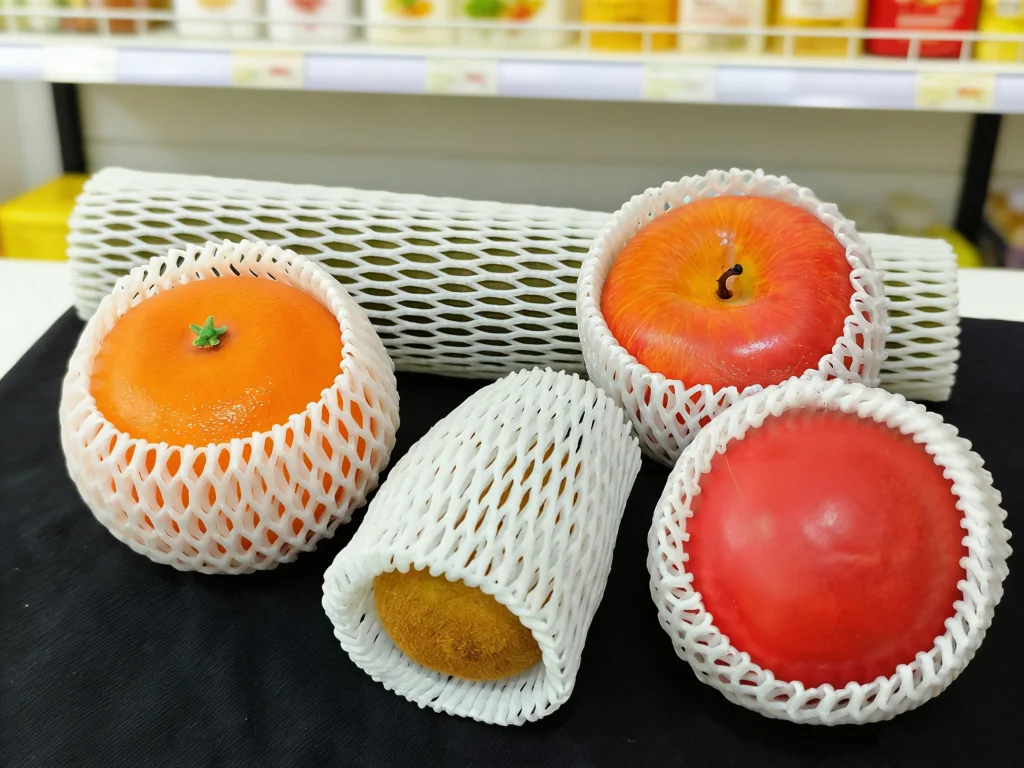
It is used on apples, pears, peaches, nectarines, tomatoes, pomegranates and kiwis, on larger fruit such as melons, and on glass bottles and ceramics.
It is a packaging method on its own, not a step before one. Some packers put fruit straight into the carton in nets; others use it alongside a tray. Either way, what the net does is protect the surface of one fruit at a time — it does not hold the load, and it does not replace the carton.
Two types: flat-end and single-end narrowed
Flat-end. The net is the same width from one end to the other, and both ends are open. It sits around the middle of the fruit, with the top and the bottom of the fruit showing.
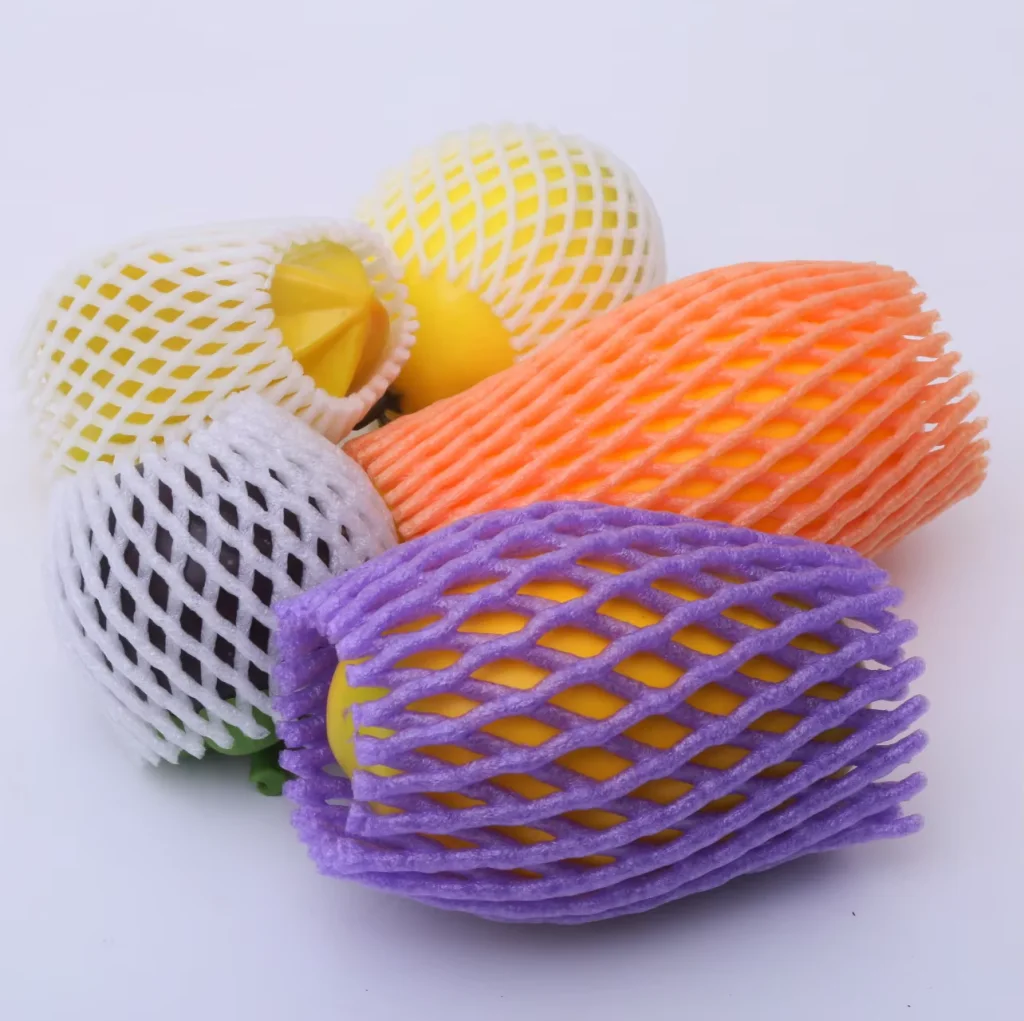
Single-end narrowed. One end of the net is narrowed, so the opening at that end is smaller than the body of the net. That narrower end sits over the top of the fruit, or over the neck of a bottle. Where the top of the fruit has to be covered as well, or where the net has to stay on a bottle, this is the type most customers order.
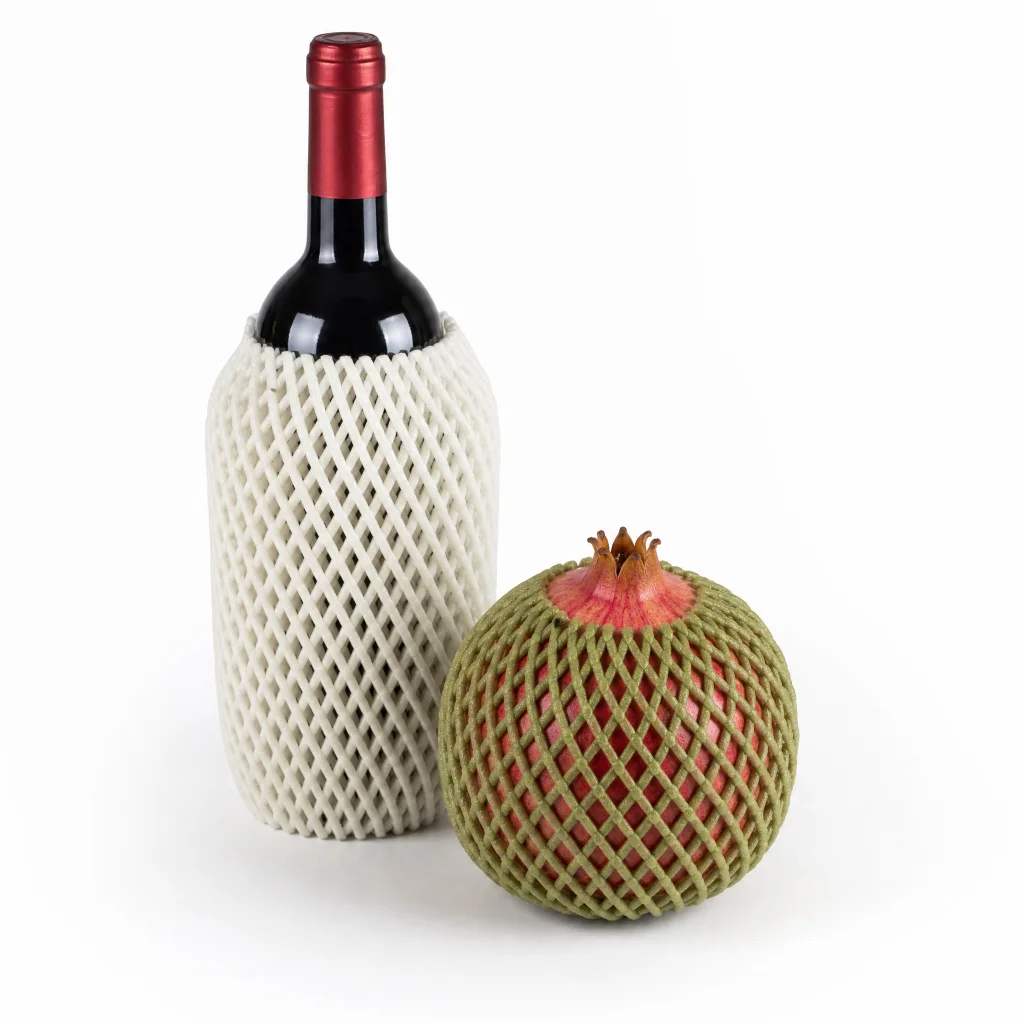
Tell us which one you need. The two are not interchangeable on a packing table.
Two materials, both fully custom
We make the net in EPE, and in a biodegradable version.
Sizes are custom for both. There is no standard size list to choose from — length, width and colour are set by the fruit you pack, and by how you want it covered.
The two materials do not share a specification sheet. EPE runs through our normal sampling route. The biodegradable version is confirmed order by order, because the material behaves differently under stretch. If your market asks for a biodegradable material, say so at the enquiry stage rather than after the sample.
The five things to specify
Width. This is the number buyers most often leave to the supplier, and it is the one that decides whether the net protects or damages. A net made for a 70 mm fruit, stretched over an 80 mm fruit, is not cushioning at that point. It is pressing. Send the diameter range you pack, not the fruit’s name.
Length. The cut length of the net, measured against your fruit. It decides how much of the fruit is covered — part of it, or the whole fruit — and whether the net stays where the packer put it through handling and transit.
Gram weight. If you have a requirement, give us the figure and we make to it. If you do not, we run the standard gram weight for that size and material, and tell you what it is before production.
Colour. Any colour is a custom item for us, not a fixed list of four. If you need certainty before a season, ask for a sample in the colour you will actually use.
Packing. 3 kg to a bag as standard.
| What we need from you | Why it matters |
|---|---|
| Fruit and diameter range | Sets the width, and the length that covers the fruit |
| Type: flat-end or single-end narrowed | Different net, different packing result |
| Gram weight (or none) | Made to your figure, or to our standard |
| Colour | Confirmed against a sample before production |
| Order quantity | One 20GP is our minimum order |
Order quantity and loading
Our minimum order is one 20GP.
For scale: a 20GP takes 200 bags at 3 kg, a 40GP 400, and a 40HC 520 — the same whatever length you order. Foam net is a light product, so a container runs out of space long before it runs out of weight. Plan on volume, not on tonnage.
Test one carton, not one net
A sample in your hand tells you about the foam. It does not tell you how the net behaves when a packer is working at speed, or how the fruit arrives.
Take a sample, net a carton of your own fruit, send it on a normal route, and open it at the other end. One carton answers more than a specification sheet can.
Questions we are asked most
What is an EPE foam net? A stretchable foam net that goes over individual fruit or bottles to protect the surface from contact damage during packing and transport. It can be used as the only packaging inside the carton.
Which size for apples or peaches? There is no standard size. Everything is cut to order from the diameter at the widest point, so send the range you pack — for example 70–80 mm — and we come back with the width and the length.
Flat-end or single-end narrowed? Flat-end when the net sits around the middle of the fruit. Single-end narrowed when the top of the fruit, or the neck of a bottle, has to be covered as well.
Is there a biodegradable version? Yes. It is confirmed order by order, because the material behaves differently from EPE.
Can the colour and gram weight be customised? Yes, both. Colour is confirmed against a sample; gram weight is made to your figure if you have one.
Send four numbers, and we will quote
The fruit, the diameter range, the type, and your order quantity. Add a gram weight if you have one — if you do not, we will use the standard and tell you what it is.
Guoliang Packing has made fresh-produce packaging in Laizhou since 2007 — EPE foam net, kraft paper fruit trays and PP/PET fruit trays, one factory.